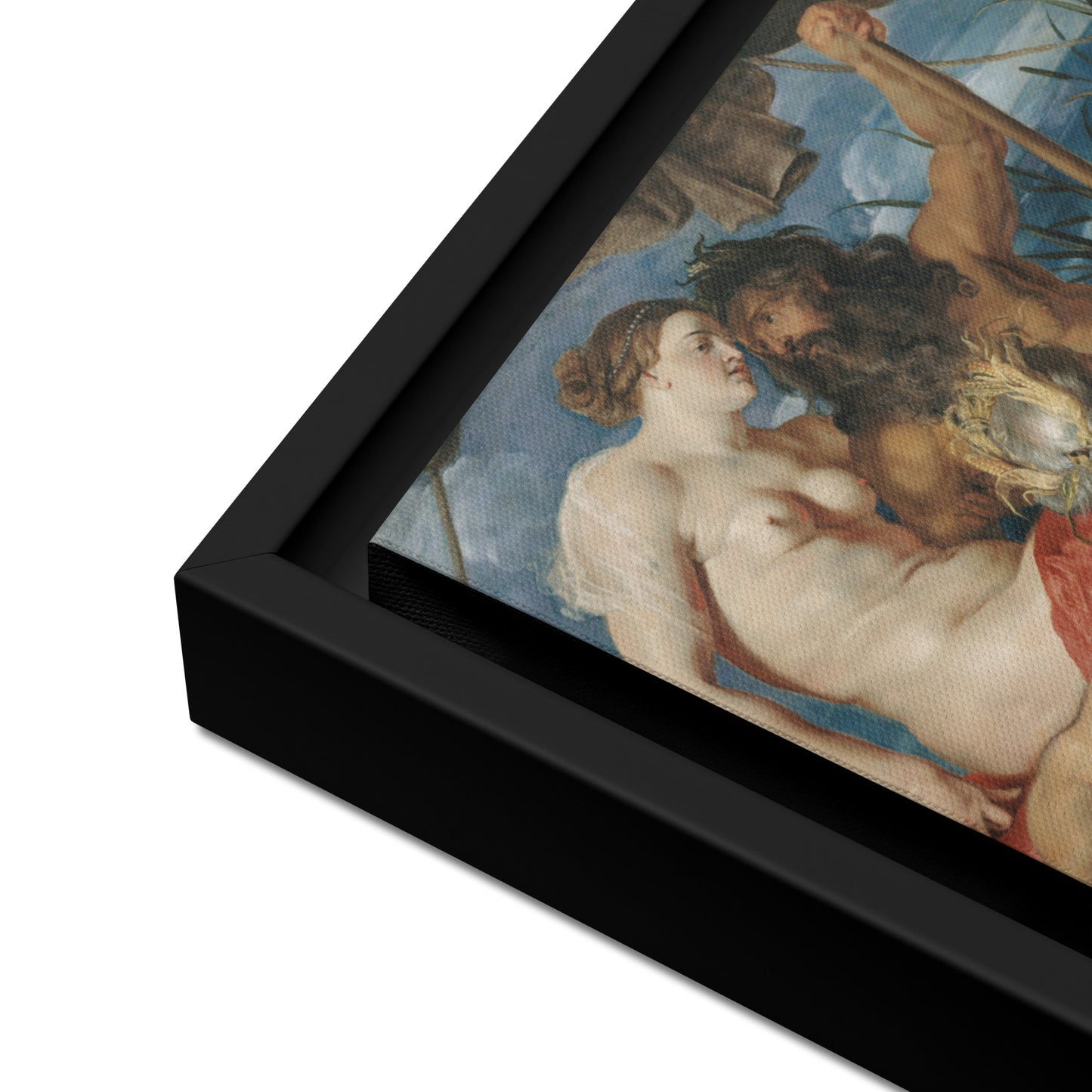
Nicolas Poussin – The Triumph of Neptune and Amphitrite
Nicolas Poussin – The Triumph of Neptune and Amphitrite
c. 1635–36 | Philadelphia Museum of Art
Oil on canvas, 114.4 × 146.6 cm
Myth and motion converge in this luminous seascape by Nicolas Poussin, a master of classical restraint who, for once, allows playfulness to take the lead. The Triumph of Neptune and Amphitrite (also sometimes titled The Birth of Venus) captures a frothy procession of sea deities with lyrical energy and radiant, sunlit color.
Inspired by ancient myth, the painting shows the moment Neptune (Poseidon to the Greeks) claims Amphitrite, his sea-nymph bride, after sending dolphins to persuade her return. She appears draped in flowing cloth, riding a dolphin beside Neptune’s shell-drawn chariot, surrounded by a retinue of Tritons, Nereids, and airborne putti. The subject—full of movement, music, and marine divinity—is evocative of earlier mythological triumphs painted by Botticelli and Raphael.
Indeed, Botticelli’s Birth of Venus (1484–86) is an obvious cousin in theme and tone, while Raphael’s Triumph of Galatea (1512) directly influenced Poussin’s composition. The putto beneath Amphitrite appears lifted nearly stroke for stroke from Raphael’s fresco in the Villa Farnesina—a quote rather than a copy.
Despite its festive tone, the painting has sparked much debate. Is the central female Venus? Amphitrite? Galatea? Art historians from Bellori to Anthony Blunt have offered conflicting titles and theories, but the consensus now points to Neptune and Amphitrite as the central theme, layered with echoes of the others.
Commissioned for Cardinal Richelieu, the painting once hung among the treasures of Catherine the Great in Russia’s Hermitage Museum before it was sold in 1930. Today, it resides in the Philadelphia Museum of Art—a radiant homage to mythological grandeur, where classical form and baroque color gently meet the surf.