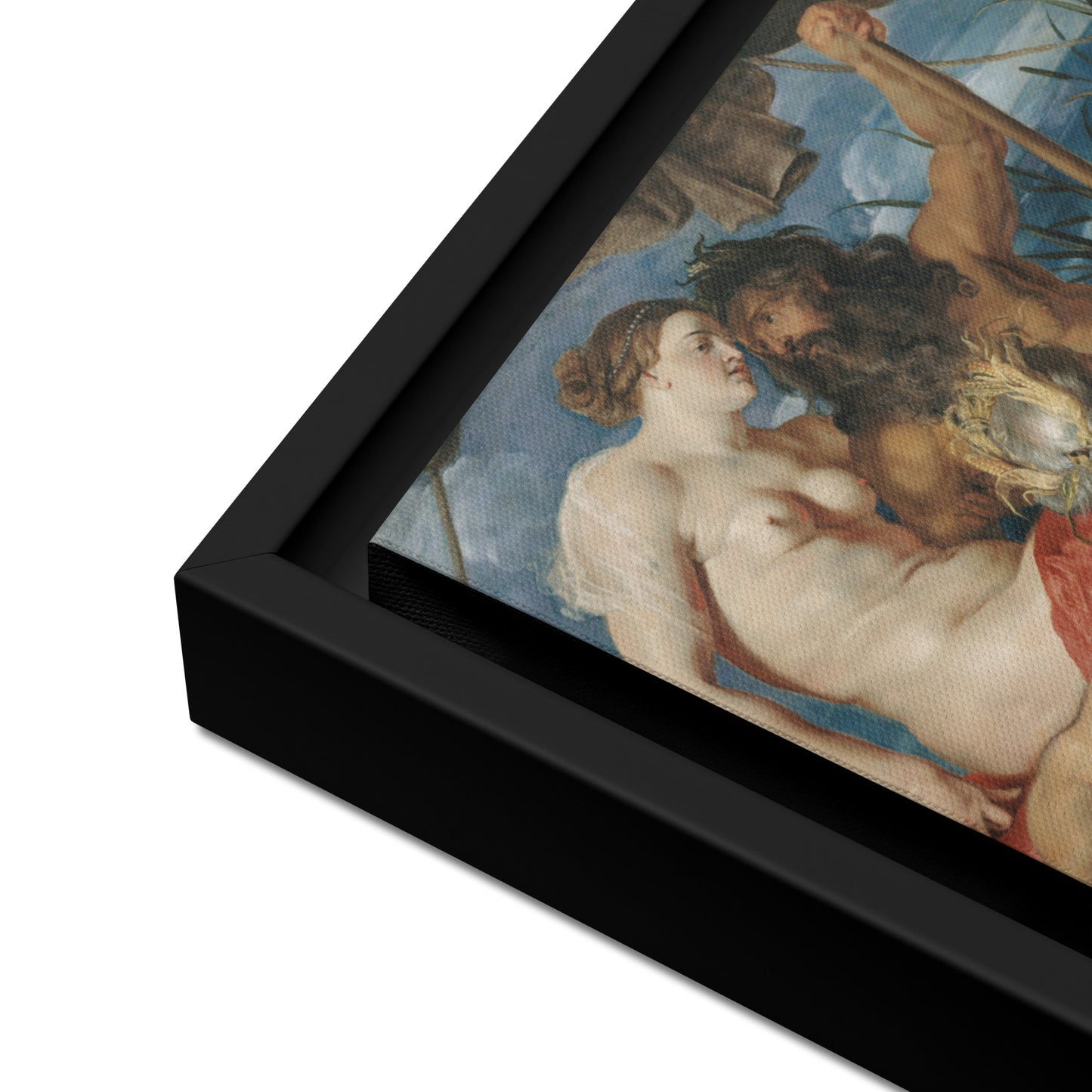
St Sibyl’s Sermon in Roman Ruins with the Statue of Apollo - Giovanni Paolo Panini, 1740–1750
St Sibyl’s Sermon in Roman Ruins with the Statue of Apollo
Giovanni Paolo Panini, 1740–1750
Oil on canvas, 124 x 85 cm
Hermitage Museum, St. Petersburg
Giovanni Paolo Panini, one of the great masters of 18th-century vedute and architectural fantasy, brings together the sacred and the classical in his evocative painting St Sibyl’s Sermon in Roman Ruins with the Statue of Apollo. Painted between 1740 and 1750, this work is a perfect example of Panini’s fascination with the grandeur of antiquity and his ability to breathe life into ruins.
The scene unfolds within the remains of a majestic Roman temple. Towering Corinthian columns, crumbling archways, and scattered architectural fragments frame the composition with theatrical elegance. In the foreground, a group of figures gathers intently around a central speaker—believed to be the Sibyl, a legendary prophetess of ancient lore. Draped in classical garments, she gestures toward the heavens as she delivers her sermon, imbuing the painting with a sense of mysticism and timeless authority.
To the right stands a statue of Apollo, god of prophecy, music, and light. Elevated on a pedestal, the statue reinforces the painting’s central theme: the convergence of divine revelation and classical heritage. The inclusion of Apollo is no accident—his presence not only recalls ancient religion but also mirrors the Sibyl’s own prophetic power, blurring the lines between pagan and Christian iconography.
Panini’s use of light is masterful. A soft golden glow filters through the ruins, casting long shadows and emphasizing the texture of aged stone. The depth created by the receding architecture and layered figures draws the viewer into the scene, creating a sense of both physical space and spiritual immersion. It is a place where history, myth, and faith coexist.
This painting is not a literal historical narrative but a constructed vision—a capriccio—that allows Panini to explore the poetic resonance of ruins and the enduring legacy of the classical world. Through this imaginative lens, St Sibyl’s Sermon becomes more than just a depiction of ancient prophecy; it becomes a meditation on the passage of time, the echoes of ancient wisdom, and the beauty of cultural memory.
Now part of the Hermitage Museum’s collection, this work stands as a testament to Panini’s talent for blending architectural majesty with allegorical storytelling. It reminds us that ruins are never truly empty—they are full of voices from the past, waiting to be heard.