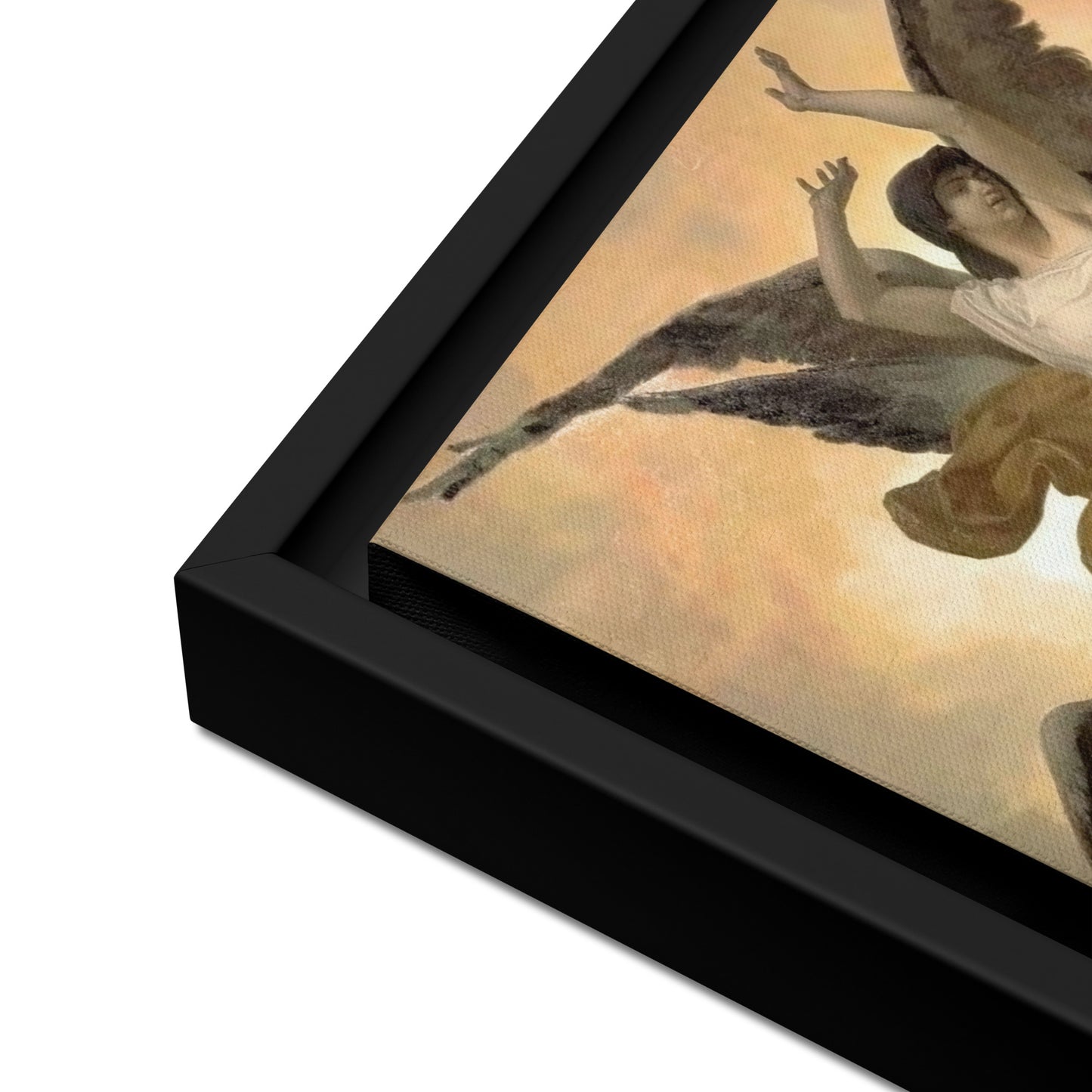
Le Remords (The Remorse): The Tragic Story of Orestes and the Furies
Louis-Marie Baader, 1875
Oil on canvas
Musée d'Orsay, Paris
Louis-Marie Baader's Le Remords (The Remorse) captures one of the most psychologically powerful moments in all of Greek mythology. Rather than depicting a heroic battle or triumphant victory, Baader focuses on the devastating aftermath of revenge. The enormous canvas freezes the instant when Orestes realizes that, although he has fulfilled his sacred duty, he can never escape the consequences of what he has done. It is a painting not about violence itself, but about guilt, justice, and the unbearable weight of conscience.
The story begins with the House of Atreus, one of the most tragic families in Greek mythology. Before leaving for the Trojan War, King Agamemnon sacrificed his own daughter, Iphigenia, to the goddess Artemis in exchange for favorable winds to sail to Troy. His wife, Clytemnestra, never forgave him. During Agamemnon's ten-year absence, she took Aegisthus as her lover, and together they plotted the king's murder. Upon Agamemnon's victorious return, the couple killed him and seized the throne of Mycenae. Fearing retaliation, they sought to eliminate Agamemnon's young son, Orestes, but his sister Electra secretly helped him escape into exile.
Years later, Orestes consulted the Oracle of Apollo, who commanded him to return home and avenge his father's death. Accompanied by his loyal friend Pylades, Orestes secretly entered the palace, killed Aegisthus, and then faced the impossible task of confronting his own mother. Torn between filial love and divine command, he hesitated before ultimately obeying Apollo and killing Clytemnestra. In that moment, justice had been served, yet a far greater punishment had only just begun.
Immediately after the murders, Orestes was pursued by the Erinyes, better known as the Furies. These terrifying ancient goddesses existed to punish crimes against family and natural law, and no offense was considered more horrific than matricide. Though Apollo had ordered the act, the Furies cared only that sacred blood had been spilled. They drove Orestes into madness, relentlessly haunting him with visions of guilt and vengeance. Their pursuit would eventually lead to Athens, where the goddess Athena established what mythology describes as the first trial by jury. After hearing arguments from both Apollo and the Furies, the jury reached a deadlock, forcing Athena herself to cast the deciding vote that acquitted Orestes. In doing so, the myth symbolically marked the transition from endless cycles of personal revenge to justice administered through law.
Baader chooses not to paint the murders themselves, but the devastating psychological collapse that follows. Orestes stands frozen in horror before the bodies of Clytemnestra and Aegisthus lying at his feet. His expression reveals that vengeance has brought no satisfaction. Surrounding him are the monstrous Furies, invisible to everyone except their victim, who swarm around him as living manifestations of guilt, remorse, and mental torment. Rather than supernatural monsters alone, they become symbols of a conscience that cannot be silenced.
Painted in 1875, Le Remords was exhibited at the Paris Salon, where it received widespread acclaim and was purchased directly by the French state. Louis-Marie Baader, a respected French Academic painter, was celebrated for his dramatic historical scenes, exceptional draftsmanship, and mastery of the human figure. Although the painting was admired in its own time, it later disappeared from public view for decades after suffering severe deterioration. Only after an extensive restoration in the twenty-first century was it once again displayed, allowing modern audiences to appreciate its extraordinary technical and emotional power.
The monumental scale of the painting enhances its emotional impact. Baader uses theatrical lighting to isolate Orestes, while the muscular anatomy of the figures reflects the influence of classical sculpture and Academic training. The dark palette and overwhelming presence of the Furies create an atmosphere of suffocating dread, making the viewer feel as trapped by guilt as Orestes himself. Every element of the composition serves to reinforce the central idea that some burdens cannot be escaped, no matter how righteous the original cause may have been.
Today, Le Remords remains one of the finest nineteenth-century interpretations of Greek tragedy. More than an illustration of an ancient myth, it is a profound meditation on justice, morality, and the lasting consequences of our choices. Baader reminds us that even when a person acts out of duty or divine command, the human heart may still carry the weight of remorse. Nearly 2,500 years after the story of Orestes was first told, its central question remains as relevant as ever: can justice truly exist without guilt, or are the two forever intertwined?