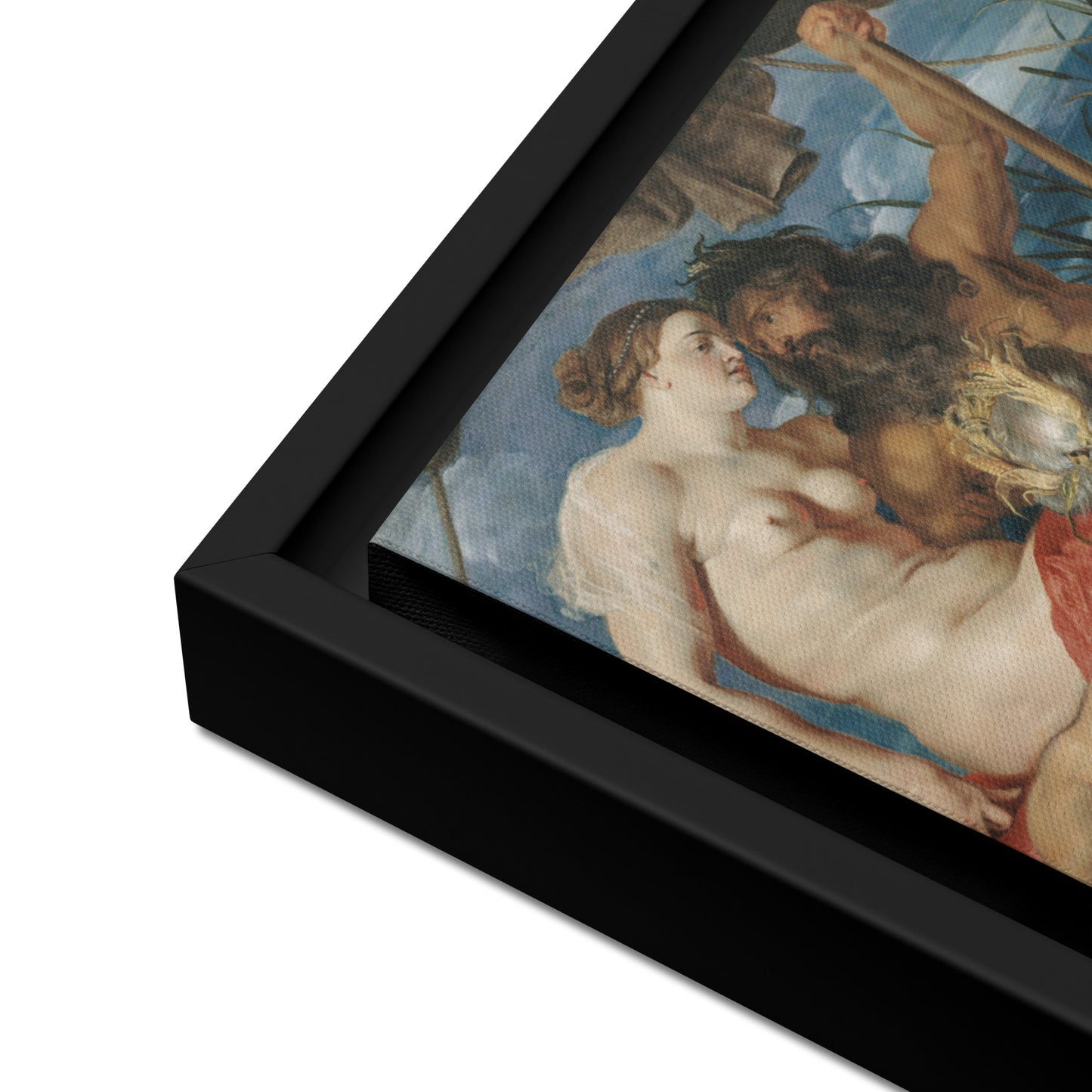
Leda and the Swan: The Greek Myth Behind Leonardo da Vinci's Lost Masterpiece
Leda and the Swan
School of Leonardo da Vinci, c. 1505–1507
Oil on panel
Uffizi Gallery, Florence
Few stories from Greek mythology have inspired as many artists as Leda and the Swan. At first glance, the painting appears serene and elegant, with a graceful woman embracing a swan amid a peaceful landscape. Yet beneath its beauty lies one of mythology's most unusual and controversial tales. The work depicts the moment when Zeus, king of the Greek gods, transforms himself into a swan in order to approach Leda, the queen of Sparta. From this extraordinary encounter would come a lineage that shaped the course of Greek mythology, including the birth of Helen of Troy, whose beauty would ultimately ignite the Trojan War.
According to the myth, Zeus became captivated by Leda's beauty and descended to earth disguised as a swan. On the same night that Zeus united with Leda, she also conceived children with her husband, King Tyndareus of Sparta. In most versions of the story, Leda later laid two eggs instead of giving birth in the ordinary way. From those eggs emerged four children: Helen of Troy and Polydeuces (Pollux), believed to be the divine children of Zeus, along with Castor and Clytemnestra, who were generally regarded as the children of Tyndareus. This remarkable birth made the myth one of the most enduring and recognizable stories of classical antiquity.
Although Leonardo da Vinci's original Leda and the Swan has been lost for centuries, it was regarded by his contemporaries as one of his most beautiful creations. The painting was last documented in the French royal collection at the Château de Fontainebleau in the early seventeenth century before disappearing, and it was likely destroyed sometime afterward. Fortunately, numerous drawings by Leonardo, along with several copies created by members of his workshop, preserve the composition. This version in the Uffizi Gallery is widely considered one of the closest surviving examples of Leonardo's lost masterpiece and is commonly attributed to his favorite pupil and closest assistant, Francesco Melzi.
The composition reflects many of the artistic innovations that made Leonardo famous. Leda stands in an elegant contrapposto pose, gently embracing the swan while gazing downward with remarkable serenity. At her feet, four infants emerge from oversized broken eggshells, immediately identifying the mythological subject. The figures possess the soft modeling and delicate transitions of light and shadow known as sfumato, one of Leonardo's defining techniques. The distant landscape, winding waterways, rocky formations, and carefully observed plants further echo the master's fascination with both nature and ideal beauty.
Leonardo explored the subject for years before completing his final composition. His surviving sketches reveal that he initially envisioned Leda kneeling beside the swan before later developing the now-famous standing figure. These drawings demonstrate his relentless pursuit of anatomical perfection and graceful movement. Art historians have even suggested that the twisting pose of Leda may have been inspired by the ancient Laocoön Group, a celebrated classical sculpture discovered in Rome during Leonardo's lifetime. Such influences reveal how deeply Renaissance artists studied antiquity while creating something entirely their own.
Beyond its mythological narrative, the painting reflects the Renaissance fascination with classical literature and the revival of ancient learning. Greek myths were no longer viewed merely as pagan stories but as rich sources of artistic inspiration that explored beauty, love, power, fate, and the complexities of human nature. Leonardo's interpretation avoids dramatic action in favor of quiet elegance, transforming a controversial myth into an idealized vision of harmony between the human figure and the natural world.
The loss of Leonardo's original painting has only increased its fascination. Without the original, scholars must reconstruct his intentions through preparatory drawings, written descriptions, and copies produced by his students. These surviving works offer a rare glimpse into one of the Renaissance's greatest lost masterpieces while also demonstrating the extraordinary skill of Leonardo's workshop, whose members carefully preserved many of his compositions for future generations.
Today, Leda and the Swan remains one of the finest surviving reflections of Leonardo da Vinci's artistic vision. Whether viewed as a masterpiece of Renaissance design, a window into Greek mythology, or a reminder of one of history's greatest lost paintings, it continues to captivate audiences more than five centuries after it was conceived. Even in the absence of Leonardo's original, its influence endures, reminding us that some of the greatest works of art continue to shape history long after the originals have disappeared.