The Annunciation: The Biblical Story Behind Orazio Gentileschi’s Baroque Masterpiece
The Annunciation
Orazio Gentileschi, 1623
Oil on canvas
Galleria Sabauda, Turin, Italy
Orazio Gentileschi's The Annunciation is one of the most beautiful and refined religious paintings of the Italian Baroque period. Completed in 1623, the masterpiece captures the extraordinary moment when the Archangel Gabriel appears before the Virgin Mary to announce that she has been chosen to become the mother of Jesus Christ. Through luminous colors, delicate gestures, and an atmosphere of profound stillness, Gentileschi transforms this miraculous encounter into an intimate scene of faith, humility, and divine grace. Rather than emphasizing overwhelming supernatural power, the artist presents a quiet moment in which heaven enters the ordinary world.
The story originates in the Gospel of Luke, where the angel Gabriel is sent by God to a young woman named Mary in Nazareth. Gabriel greets her with the announcement that she has found favor with God and will conceive a son named Jesus, who will be called the Son of the Most High. Initially troubled and confused by the message, Mary asks how such a thing could happen. Gabriel explains that the Holy Spirit will come upon her and that nothing is impossible with God. Mary's eventual acceptance, expressed in her willingness to serve the divine plan, makes the Annunciation one of the defining moments in Christian theology.
Gentileschi places the Archangel Gabriel on the left side of the composition, kneeling before Mary in magnificent golden robes. His enormous wings rise behind him, while one hand gestures toward heaven, emphasizing that his message comes directly from God. In his other hand, Gabriel holds a delicate stem of white lilies, a traditional symbol of Mary's purity and innocence. His youthful appearance, graceful posture, and richly illuminated garments give him an almost tangible presence. Despite his heavenly origins, Gabriel appears remarkably human, allowing the viewer to experience the encounter as a personal conversation rather than a distant religious vision.
Opposite the angel stands the Virgin Mary, dressed in a brilliant blue mantle over a rose-colored garment. Her lowered gaze and gently raised hands communicate surprise, modesty, and quiet acceptance. Gentileschi avoids exaggerated expressions or theatrical movements, instead allowing Mary's restrained gestures to reveal the emotional significance of the moment. Beside her stands a simple bed covered with carefully arranged white linens, grounding the miraculous event within an ordinary domestic interior. The contrast between the humble setting and the extraordinary announcement reinforces the Christian belief that divine grace can enter even the simplest human surroundings.
Above the figures, a white dove descends through a radiant opening of light, representing the Holy Spirit and the miraculous conception of Christ. The dove completes the painting's spiritual symbolism, connecting Gabriel's announcement with the divine presence entering Mary's life. Light plays an especially important role throughout the composition, illuminating the angel's golden robes, Mary's face, and the folds of their garments. Rather than relying on dramatic supernatural effects, Gentileschi allows the gentle brilliance of natural-looking light to suggest the sacred nature of the encounter.
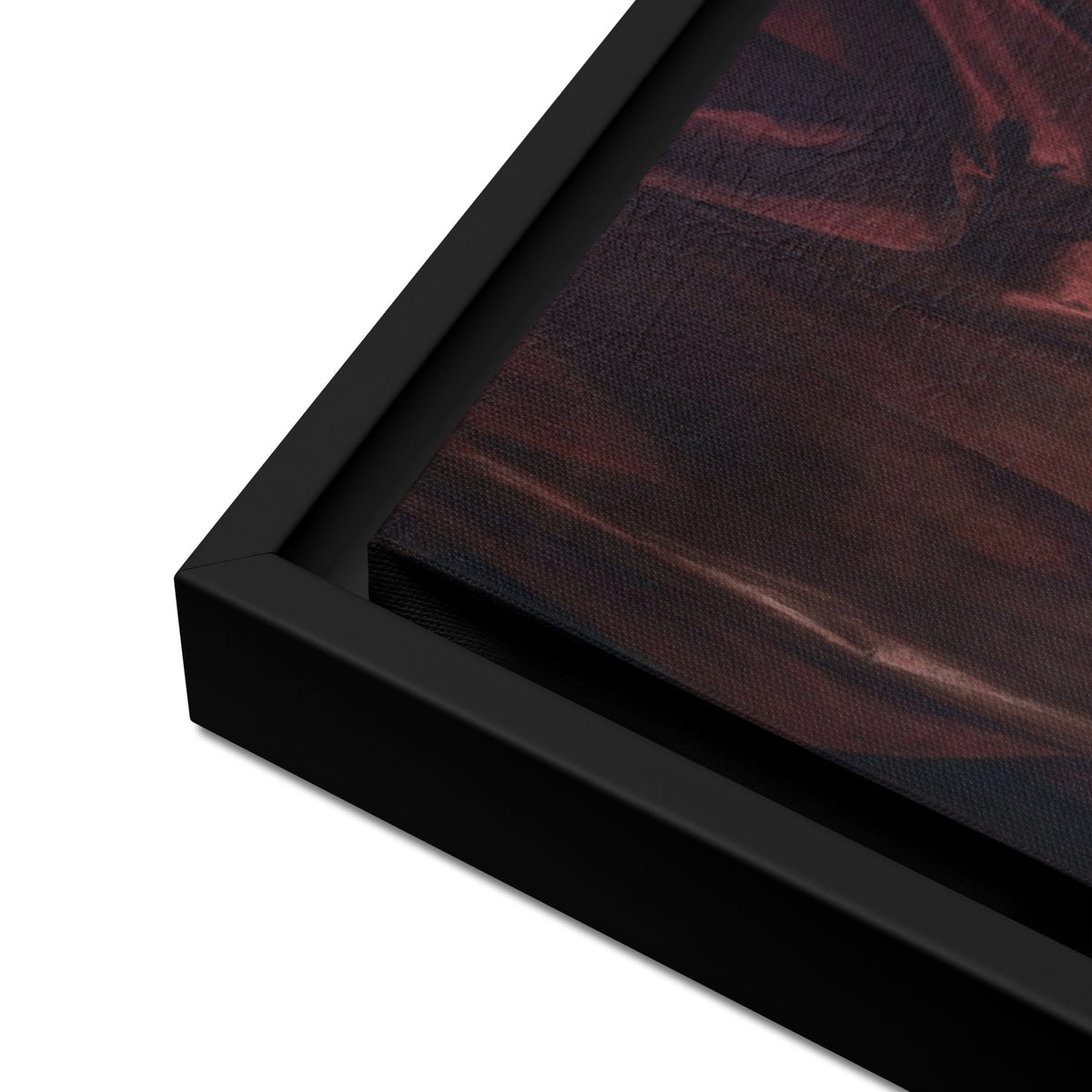
One of the painting's most striking features is the enormous crimson curtain that hangs behind Mary, unfolding in deep, luxurious folds. Its rich red color contrasts beautifully with Mary's blue mantle and Gabriel's golden garments, creating a harmonious arrangement of color that draws the viewer toward the central figures. The curtain also gives the scene a theatrical quality, as though a sacred event is being revealed upon a stage. Gentileschi's extraordinary attention to fabric is evident in every detail, from the shimmering silk of Gabriel's clothing to the soft white bedsheets and the heavy folds of the curtain. These carefully observed textures demonstrate his exceptional ability to transform ordinary materials into objects of remarkable beauty.
Although Gentileschi was deeply influenced by Caravaggio, whose revolutionary naturalism transformed Italian painting at the beginning of the seventeenth century, he developed a distinctly different artistic personality. Caravaggio often employed intense darkness, dramatic contrasts, and emotionally charged realism, while Gentileschi increasingly favored elegant compositions, graceful figures, and luminous color. The magnificent red curtain recalls the dramatic drapery in Caravaggio's Death of the Virgin, yet Gentileschi's treatment is softer and more refined. His figures possess a calm dignity that reflects both his mastery of naturalism and his growing interest in the elegance of courtly painting.
The painting also has a fascinating history connected to Gentileschi's ambitions as an artist. Completed during his time in Genoa in 1623, The Annunciation was presented to Charles Emmanuel I, Duke of Savoy, as a diplomatic gift. Gentileschi accompanied the painting with a letter offering his artistic services, hoping that the magnificent work would help him secure a prestigious appointment at the Savoy court. Although the desired position never materialized, the painting entered the ducal collections and remained associated with the House of Savoy. Today, it is preserved in the Galleria Sabauda in Turin, where it stands among the finest examples of Gentileschi's mature artistic achievement.
More than four centuries after its creation, The Annunciation remains a remarkable expression of the beauty and spiritual depth of Baroque painting. Gentileschi captures an event that would change the course of Christian history, yet he presents it through the simplest human emotions: surprise, humility, trust, and acceptance. The radiant angel, the contemplative Virgin, and the descending Holy Spirit come together in a composition of extraordinary balance and tenderness. Through his mastery of light, color, and human expression, Gentileschi transforms a familiar biblical story into a timeless meditation on the meeting of the divine and the human.