The Birth of Venus: The Story Behind Bouguereau's Mythological Masterpiece
The Birth of Venus
William-Adolphe Bouguereau, 1879
Oil on canvas
Musée d'Orsay, Paris
William-Adolphe Bouguereau's The Birth of Venus is one of the defining masterpieces of nineteenth-century Academic art. Towering nearly ten feet high, the monumental canvas is celebrated for its astonishing technical precision, idealized beauty, and graceful interpretation of classical mythology. Today it hangs in the Musée d'Orsay in Paris, where it continues to captivate visitors with its luminous color, flawless anatomy, and breathtaking scale. Although inspired by ancient mythology and Renaissance art, Bouguereau's interpretation possesses a distinctly nineteenth-century elegance that made it one of his greatest artistic achievements.
Despite its title, the painting does not depict the actual birth of Venus from sea foam. Instead, it illustrates the goddess's arrival on the shores of Cyprus after her miraculous birth. According to Greek mythology, Aphrodite—known to the Romans as Venus—was born from the sea after the severed remains of the sky god Uranus fell into the ocean, creating a mass of white foam from which the goddess emerged. Rather than showing this dramatic origin, Bouguereau presents Venus as a fully grown goddess standing atop a giant scallop shell as she is carried gracefully toward land, symbolizing the arrival of beauty, love, and desire into the world.
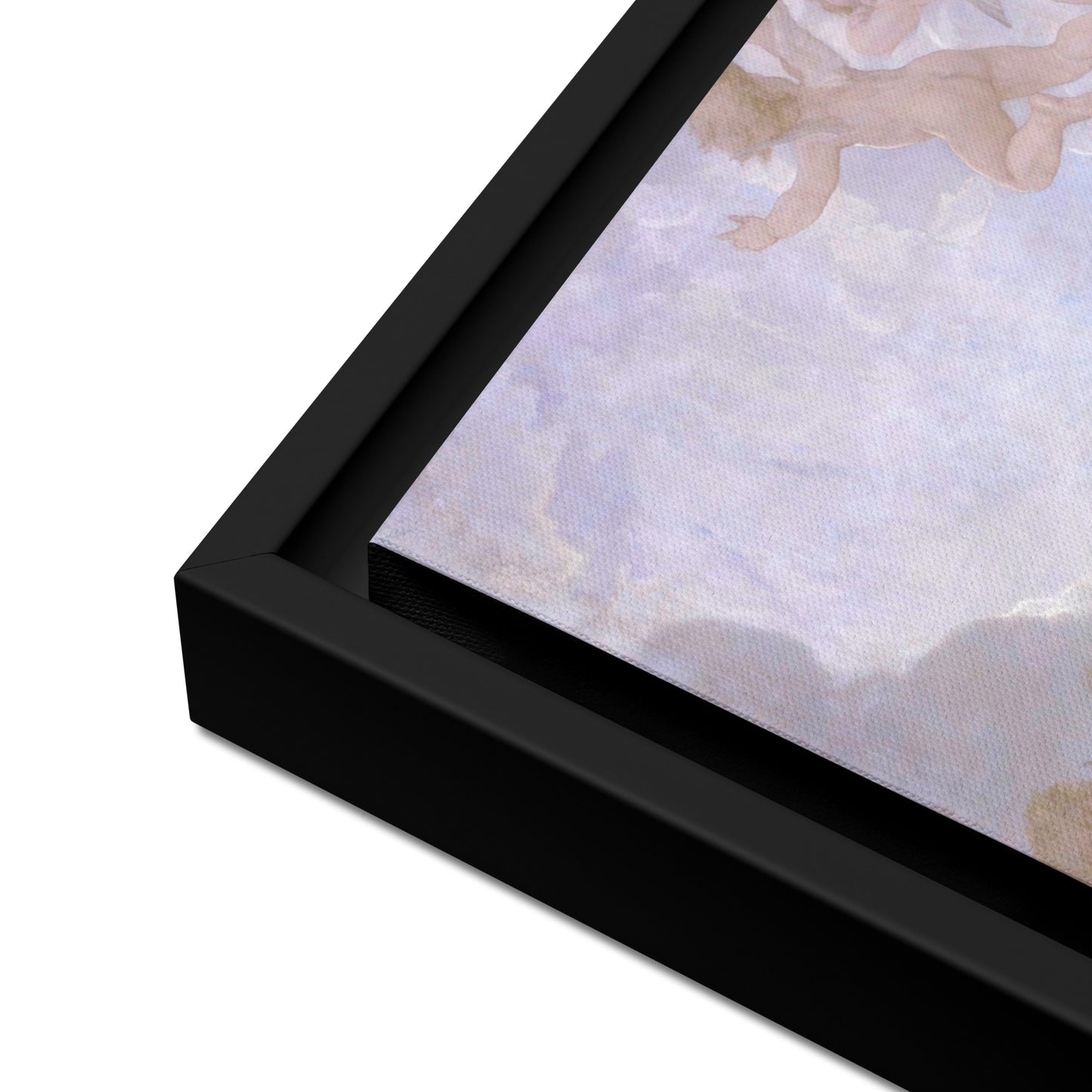
At the center of the composition stands Venus herself, rendered with porcelain-like skin and an elegant contrapposto pose that recalls the great sculptures of antiquity. She gently lifts her arms to gather her long flowing hair, completely at ease in her nudity. Surrounding her is a jubilant procession of twenty-two mythological figures. Sea nymphs, tritons, centaurs, and putti celebrate her arrival, while two mermen sound conch shell trumpets to announce the goddess's appearance. Above, Cupid and Psyche are among the cherubs who float effortlessly through the sky, completing the heavenly spectacle.
Bouguereau's technical mastery is evident in every inch of the painting. The figures are modeled with extraordinary anatomical accuracy, yet they retain an idealized perfection that reflects the values of French Academic painting. Warm flesh tones glow against the cool blues and soft pastels of the sea and sky, while the nearly invisible horizon creates an ethereal atmosphere that seems to suspend Venus between heaven and earth. The composition is carefully balanced, with the stronger, muscular male figures offsetting the softer elegance of the female forms, guiding the viewer's eye naturally toward the radiant goddess at the center.
The painting also pays homage to some of the greatest artists of the Renaissance. Bouguereau drew inspiration from Sandro Botticelli's The Birth of Venus and Raphael's The Triumph of Galatea, adapting their classical compositions into his own highly polished Academic style. Unlike Botticelli's Venus, who modestly attempts to cover herself, Bouguereau's goddess embraces her divinity with confidence and serenity. Her pose conveys not vulnerability, but timeless perfection, reflecting the nineteenth-century Academic ideal of beauty as something eternal and unattainable.
When The Birth of Venus debuted at the Paris Salon in 1879, it was immediately embraced by critics and collectors who admired Bouguereau's extraordinary craftsmanship. The French government quickly purchased the painting for the national collection, recognizing it as one of the era's greatest artistic achievements. Yet its success also coincided with the rise of Impressionism. While traditional audiences praised its flawless execution, many modernist artists criticized the work as overly idealized, arguing that technical perfection came at the expense of emotional authenticity. This divide reflected the larger transformation taking place in the art world during the late nineteenth century.
There are also fascinating details hidden within the painting that reward careful observation. Venus herself was adapted from a figure in Bouguereau's earlier painting The Nymphaeum, though her pose was refined and her proportions subtly altered to create an even greater sense of grace. Some scholars have also suggested that a faint silhouette hidden within the upper-left clouds resembles Bouguereau himself, appearing to hold a paintbrush as though quietly observing the divine scene he created. Whether intentional or coincidental, it remains one of the painting's most intriguing mysteries.
Today, The Birth of Venus remains one of William-Adolphe Bouguereau's greatest masterpieces and one of the finest examples of French Academic painting. More than a celebration of mythology, it is a celebration of artistic excellence itself. Every figure, every fold of fabric, every strand of hair demonstrates Bouguereau's relentless pursuit of perfection. Nearly 150 years after its creation, the painting continues to stand as a timeless reminder that beauty, when united with extraordinary technical skill, possesses the power to transcend generations.