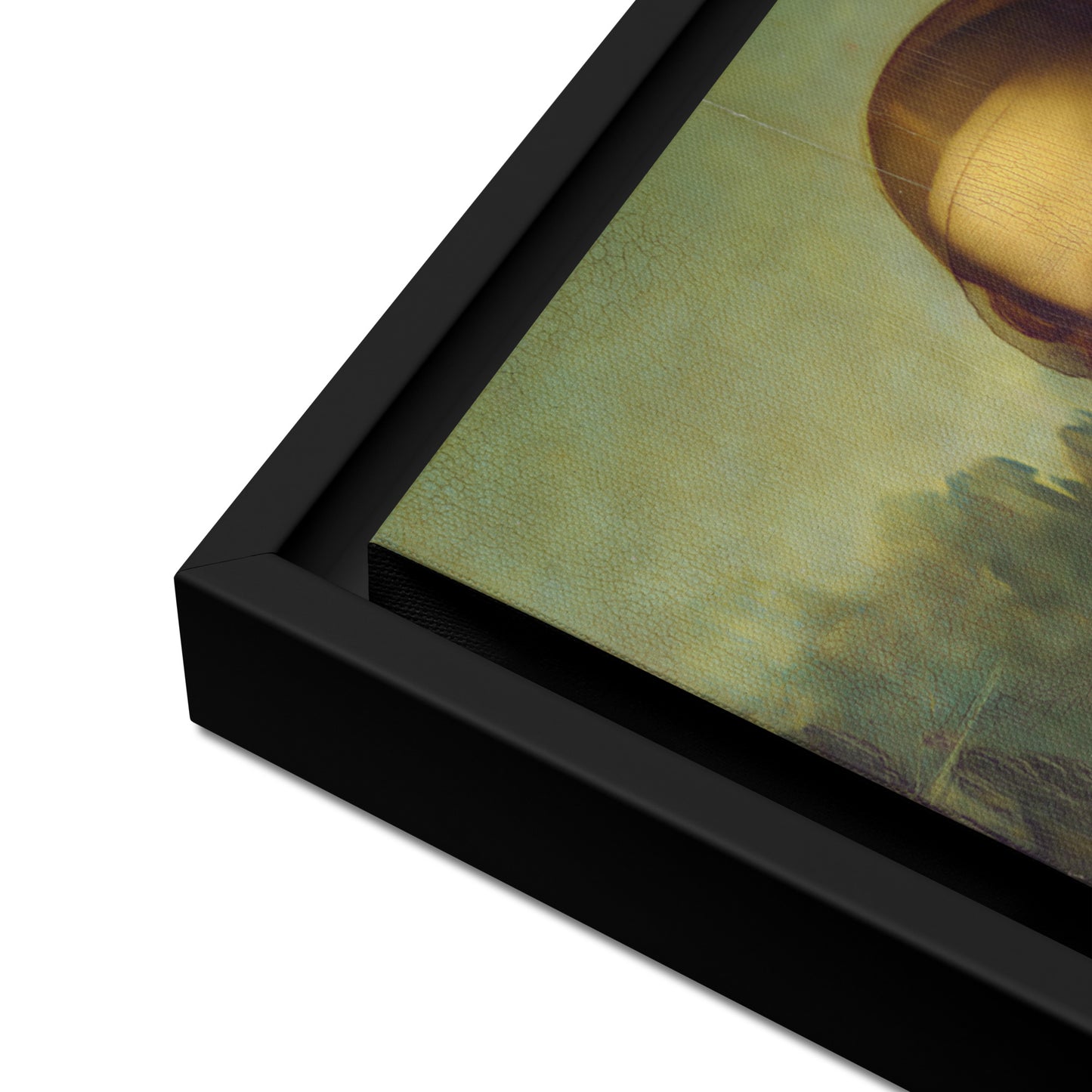
Why Is the Mona Lisa So Famous? The Mystery Behind the World’s Most Iconic Painting
Mona Lisa
Leonardo da Vinci, c. 1503–1519
Oil on poplar panel
Louvre Museum
Few works of art have achieved the level of fame, fascination, and cultural dominance as Leonardo da Vinci’s Mona Lisa. It is often called the most famous painting in the world—not simply for its artistic brilliance, but for the centuries of mystery that surround it. At first glance, it is quiet and restrained. A woman sits calmly, her hands folded, her gaze steady. And yet, something about her has captivated humanity for over 500 years.
Part of this fascination comes from Leonardo’s revolutionary technique. Using sfumato, he softened every edge, blending light and shadow so delicately that the figure appears almost alive. There are no harsh outlines, no clear boundaries—only transitions. This gives the painting its lifelike presence, as if the woman exists somewhere between reality and illusion, caught in a moment that never fully settles.
But it is her expression—especially her smile—that has made the painting legendary. Why is she smiling? The answer is not simple, and that is precisely the point. When viewed directly, her smile appears faint, almost nonexistent. But when seen through peripheral vision, it becomes more pronounced. Leonardo achieved this through subtle shading around the mouth and eyes, creating an optical illusion that shifts depending on how you look at her. The result is unsettling in the best way: a face that seems to change as you observe it.
The identity of the woman adds another layer to the mystery. Was she a real person? Most scholars believe she was Lisa del Giocondo, the wife of a Florentine merchant, commissioned as a private portrait. Yet absolute certainty remains just out of reach. Over time, theories have emerged suggesting she could be a noblewoman, an idealized figure, or even a reflection of Leonardo himself. Like her expression, her identity resists final answers.
The painting’s fame, however, is not due to artistic innovation alone. In 1911, it was stolen from the Louvre by Vincenzo Peruggia, an event that transformed it into a global sensation. For two years, the painting was missing, dominating headlines around the world. When it was finally recovered, its notoriety had grown beyond the art world, embedding it into popular culture in a way no painting had before.
Despite its immense reputation, the Mona Lisa is surprisingly small—only about 30 by 21 inches. Many visitors expect something monumental, only to find an intimate portrait behind thick protective glass. Today, it is carefully preserved, shielded from damage after multiple incidents over the years, including vandalism attempts.
Another question often asked is how much the Mona Lisa is worth. While technically priceless, it was insured in 1962 for $100 million—an amount that would exceed $1 billion today. It holds the record for the highest known insurance valuation of any painting. Yet it will never be sold, as it is considered a national treasure of France.
Beyond its fame, the painting is filled with subtle details that continue to intrigue. She appears to have no eyebrows, though evidence suggests they may have faded over time. The landscape behind her feels dreamlike and distant, adding to the sense of ambiguity. Even the panel itself—painted on wood rather than canvas—reminds us of the delicate balance between permanence and fragility.
In the end, the Mona Lisa endures not because it gives us answers, but because it withholds them. Its power lies in uncertainty—in the shifting smile, the unclear identity, the quiet tension between stillness and life. It invites endless interpretation, ensuring that each generation sees something new. And perhaps that is the true genius of Leonardo da Vinci: he created not just a portrait, but a mystery that will never be solved.